“Mutual aid” is often discussed today as something improvised in emergencies: neighbourhood food networks during Covid, tenant groups resisting eviction, volunteers stepping in when the state withdraws. Religion, if it appears at all, is usually treated as private belief—or as a conservative obstacle to change.
Researching Republican-era China (roughly the 1910s to the 1940s), however, provides a different picture. Reform-minded Buddhists around the monk Taixu (1890–1947) treated mutual aid as a moral test for modern society: do our everyday arrangements protect the weak, or do they normalise making the weak expendable? What is striking is where they located that test: not only in constitutions or economic systems, but in eating, ritual, and the small habits through which people learn what “strength” looks like.
For these writers, vegetarian practice was not a niche monastic rule. It became a practical way to train non-violence, build communities of care, and extend responsibility beyond humans to animals. That makes this history relevant to today’s debates on food systems, welfare, and climate justice—fields where “mutual aid” is increasingly asked to do slow, long-term work rather than just short bursts of crisis response.
From “the weak are meat; the strong eat” to mutual aid
Around 1900, a brutal slogan—“the weak are meat; the strong eat”—circulated widely as a description of history. Social-Darwinist language seemed to explain imperialism, capitalism, and war. At the same time, Chinese radicals were reading European critics of that fatalism. Peter Kropotkin argued that cooperation is as fundamental in evolution as competition in Mutual Aid: A Factor of Evolution. Leo Tolstoy insisted that non-violence and simple living must be lived, not merely praised in his essay “The First Step”.
Across these debates, a recognisable ethical package took shape: cooperation over domination, protection of the weak, voluntary association, frugality, and shared labour. This bundle of values still underpins many contemporary debates about welfare, food justice, and grassroots democracy, even when “mutual aid” is not named explicitly. Buddhist reformers translated it into a Buddhist idiom of compassion, non-killing, and responsibility for the suffering one causes—especially suffering hidden inside “normal” prosperity.
Taixu: vegetarianism as everyday anti-violence
Taixu (1890–1947) was one of the most influential reformers of Chinese Buddhism in the Republican era, advocating a “modern Buddhism” oriented toward social engagement and the problems of this-worldly life.Taixu is best known as a modern Buddhist reformer, but he is also a clear example of how religious thinkers linked personal discipline to global politics. In his writing on vegetarianism, he treated abstaining from meat as concrete training in non-violence. His thinking was simple: if you remove the habit of taking life for taste, it becomes easier to weaken the broader “thought of killing” that fuels cruelty and war.
He also pushed the point beyond personal purity. Societies habituated to mass killing—of animals or humans—would struggle to build lasting peace, he argued; cultures that normalised restraint in everyday life could make room for social harmony. In practical terms, vegetarian halls and lay associations mattered because they turned that ethic into routine: a way of eating, meeting, donating, and learning that did not depend on a single moment of moral heroism. For readable scholarly context on Taixu, see for instance “Taixu and the Question of Labour” and Tao Jiang’s “A Buddhist Scheme for Engaging Modern Science: The Case of Taixu”.
Fushan: mutual aid as a law of life
If Taixu sketches the moral horizon, the monk-publicist Fushan shows how “mutual aid” could be made to sound like Buddhist common sense rather than a borrowed European slogan. In an essay explicitly discussing Kropotkin’s theory, he starts with the familiar modern story—Malthus, Darwin, and the idea that life advances through struggle—then flips the premise. Cooperation, he argues, is not a sentimental extra; it is a condition of survival.
His key move is to connect this to a Buddhist account of interdependence. Modern “life theory”, he says, already reveals what Buddhism has long insisted: nothing exists by itself. Bodies persist through internal cooperation and external supports. Mutual aid therefore describes how life works—and sets a standard by which institutions can be judged. Arrangements that normalise sacrificing the weak are not “realistic”; they are blind to the dependencies that sustain them.
For that reason Fushan refuses to keep mutual aid within the human world. His vegetarian essays push the logic into interspecies responsibility: humans and animals differ in form and circumstance, not in their vulnerability to suffer. Eating flesh is not a neutral preference; it is a daily rehearsal of “the strong living off the weak”. Refusing meat becomes a small but concrete way to side with the weak.
Lü Bicheng: compassion as public activism
This was not only a monastic conversation. Lay writers helped turn it into public activism. One prominent figure was Lü Bicheng (1883–1943), a journalist and Buddhist sympathiser who wrote about Western animal-protection movements and argued for building similar organisations in China, as a recent study of her Buddhist activism shows.
Lü’s writing matters because it treats compassion as a public language, not a private sentiment. A civilised society, she suggested, restrains power—so that strength is not exercised at the expense of those who cannot speak back. Around these circles, print culture did practical work: periodicals circulated arguments for “protecting life”, reported cruelty cases, and advertised vegetarian venues where readers could act on the ethic immediately—through food, donations, and community participation.
Why this matters for religion and global society
This Republican-era Buddhist story complicates two common assumptions in today’s debates: that mutual aid is mainly secular and emergency-driven, and that religion is either private identity or political reaction. In this Chinese case, religious actors developed an explicitly anti-fatalist ethic against “the strong devouring the weak”, anchored it in everyday practice, and extended care beyond humans—anticipating contemporary debates where food, climate, and animal welfare are inseparable. For a recent open-access overview of “moral vegetarianism” in Republican China, see C. Paul, “Moral Vegetarianism in Republican China” (1912–1949).
The takeaway is not “copy China” or “become Buddhist”. It is a practical question for policymakers, civil society, and faith-based organisations: what would it mean to treat mutual aid as something societies rehearse daily—through food systems, public norms about harm, and the small institutions where people learn cooperation? When mutual aid becomes infrastructure, it is harder to dismiss as mere sentiment. And when harm to animals is treated as part of the moral landscape, “protecting the weak” becomes a genuinely global political question.
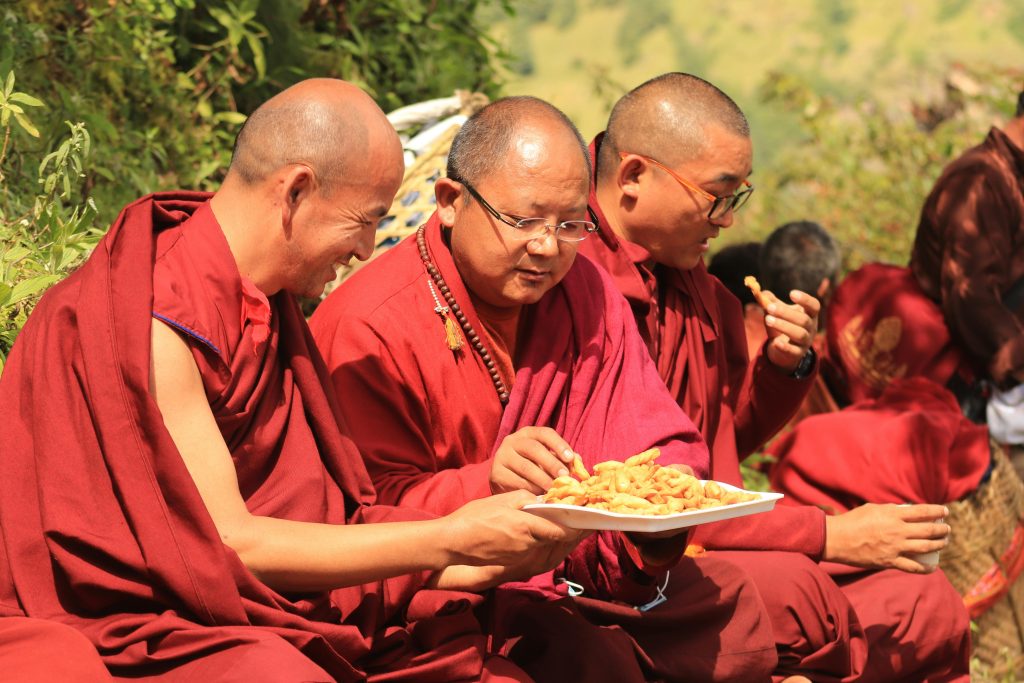
Photo by Karma Samten from Pexels
Note: This article gives the views of the author, not the position of LSE Religion and Global Society nor the London School of Economics and Political Science.